
Critical Thinking Practice Questions and Training
Sharpen your thinking just by choosing.
The Thinking Gym
1,900+ practice questions in critical thinking and logical thinking. On your phone, with no typing, you just choose your answers. Work through quick questions that train you to tell questions, claims, and premises apart, and build the habit of thinking rationally. It's free, and you can start without logging in.
Enter the Thinking GymIt's free. If you log in, your medals and personal bests follow you to other devices.
What you can do in the Thinking Gym
Just choose your answer
Tap a choice, swipe a card left or right, or draw a line between matching items. With no typing, you can keep going on your phone, even on the train.
1,900+ practice questions
From how questions and claims fit together to making questions clear, staying on the same question, choosing questions that matter, objective premises, and spotting falsehood. Every level has 100 practice questions.
Guides with examples
Every level has a Guide, where Ponder walks you through one example question. Even on your first try, you'll know what you're looking for.
Training
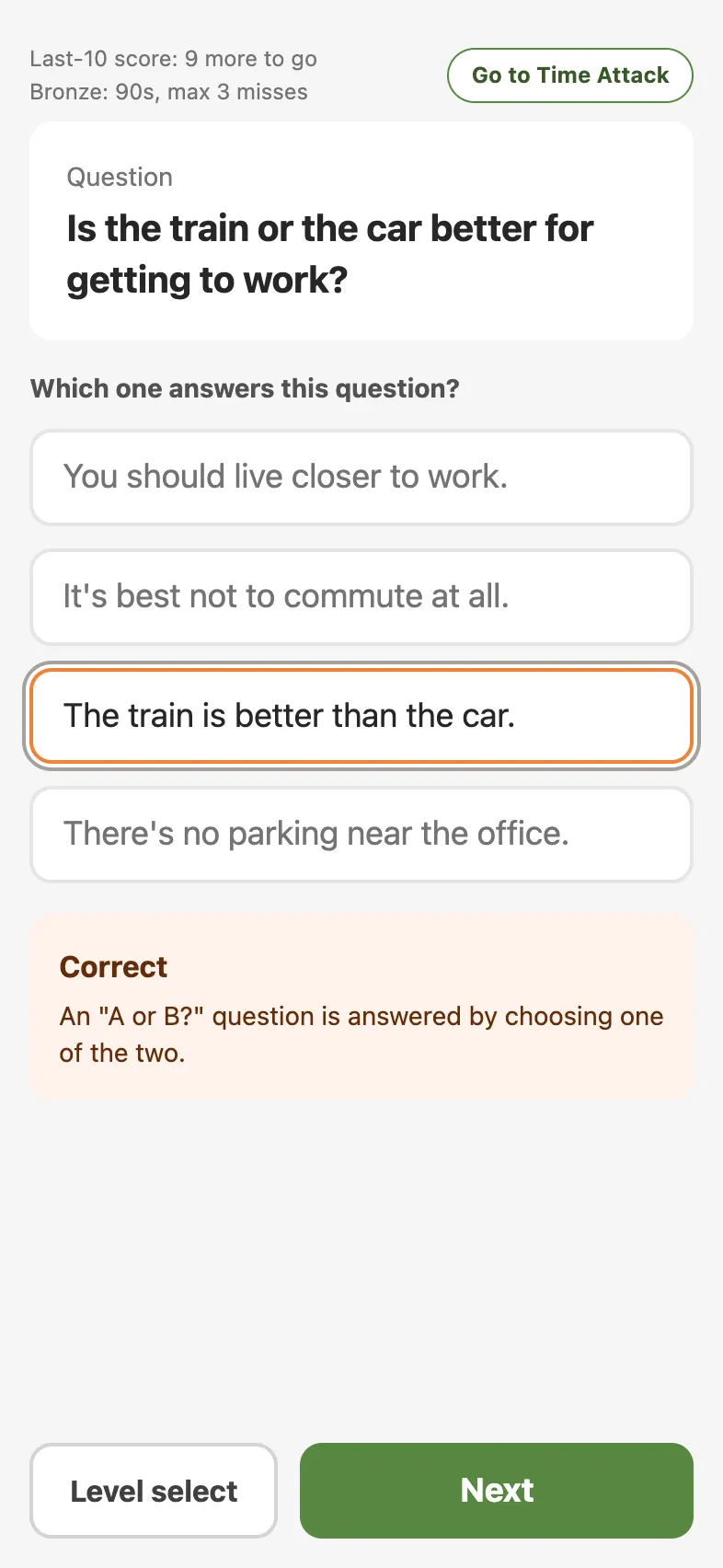
Think through one question at a time, at your own pace. After you answer, you get an explanation, and you can see why the other choices are wrong, too.
Time Attack and medals
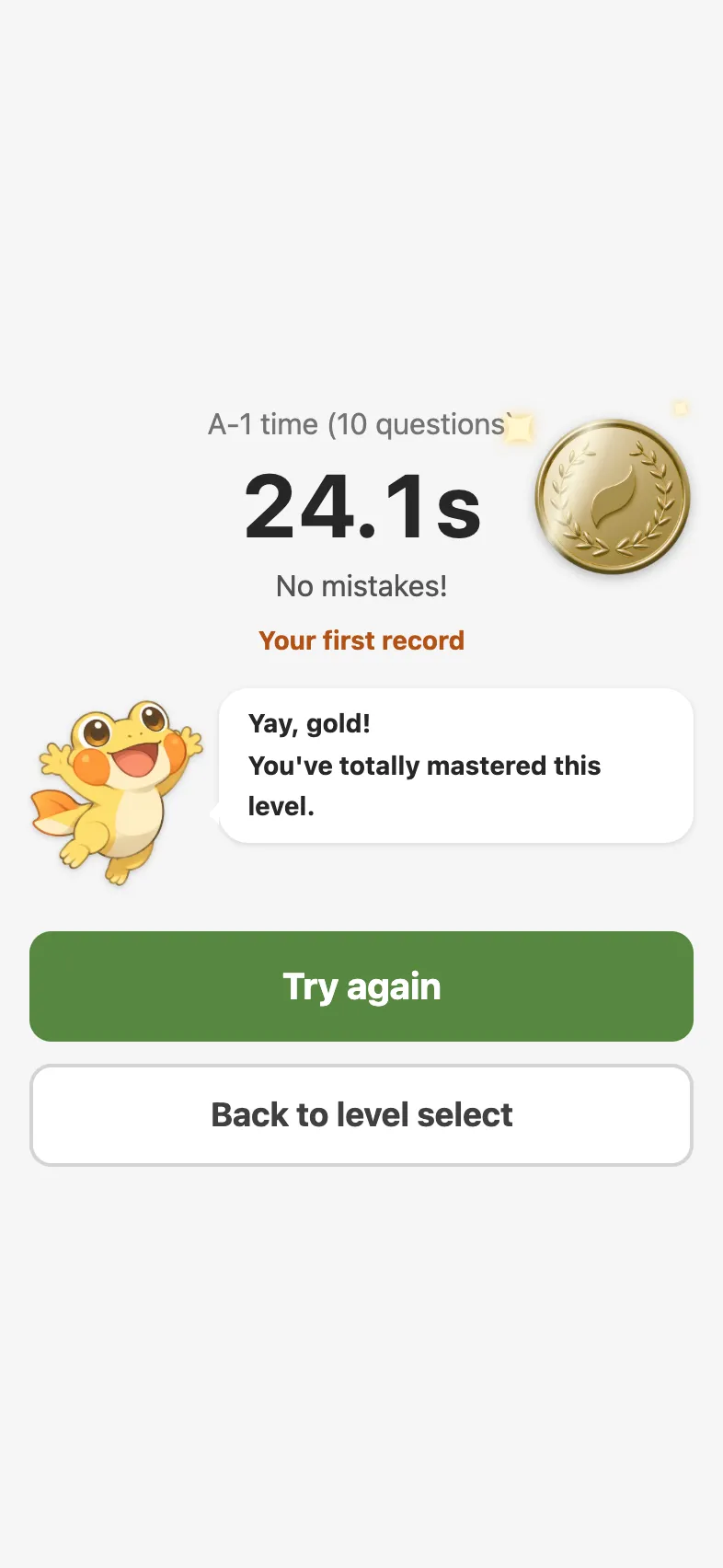
Answer 10 questions quickly and accurately to win a gold, silver, or bronze medal. Each mistake adds 5 seconds. Keep at it until you can judge each one at a glance.
Free, no login needed
Everything is free. You can use it without logging in, and your records stay on that device. Log in, and your medals and personal bests follow you to other devices.
Critical thinking, logical thinking, and rational thinking
Ways of thinking that lead to the right answer go by many names. The book behind the Thinking Gym, Critical Thinking in the Age of AI, sorts the major ones like this.
- Critical thinking
- The name most often used for school courses that teach how to think about what is right. It mainly deals with informal logic, the logic and soundness of everyday arguments.
- Logic and logical thinking
- Focuses on logical validity, the subject of formal logic.
- Scientific thinking
- Focuses on the objectivity of premises. In the Thinking Gym, course E, Objective Premises, covers this.
- Rational thinking
- Brings all of these together and deals with what is right as a whole. This is what you practice in the Thinking Gym.
Whatever name you learned it under, you start from the shared foundation of questions, claims, and premises, and then master the conditions of rationality one at a time through practice questions.
Courses and levels
The courses follow the order of the "conditions of rationality" in the book Critical Thinking in the Age of AI. You can pick any level from the start.
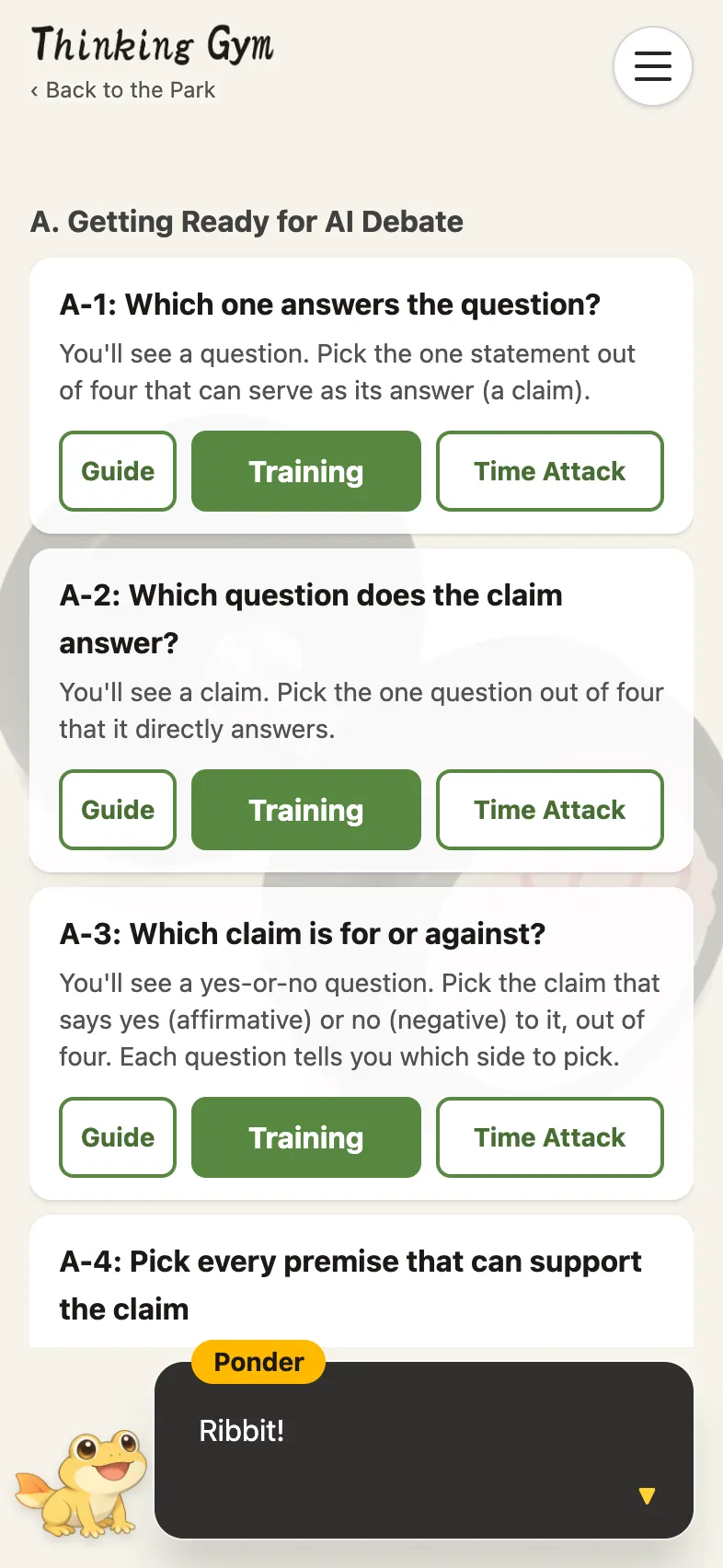
A. Getting Ready for AI Debate
- A-1: Which one answers the question?
- A-2: Which question does the claim answer?
- A-3: Which claim is for or against?
- A-4: Pick every premise that can support the claim
B. Make the Question Clear
- B-1: Which word is an adjective or adverb?
- B-2: Which one is clear?
- B-3: How would you put it in numbers?
- B-4: What is the request really asking?
C. Stay on the Same Question
- C-1: Are they on the same question?
- C-2: Which reply goes with which question?
- C-3: What should A say next?
D. Think About Questions That Matter
- D-1: Which issue isn't worth thinking about? (1)
- D-2: Which issue isn't worth thinking about? (2)
E. Objective Premises
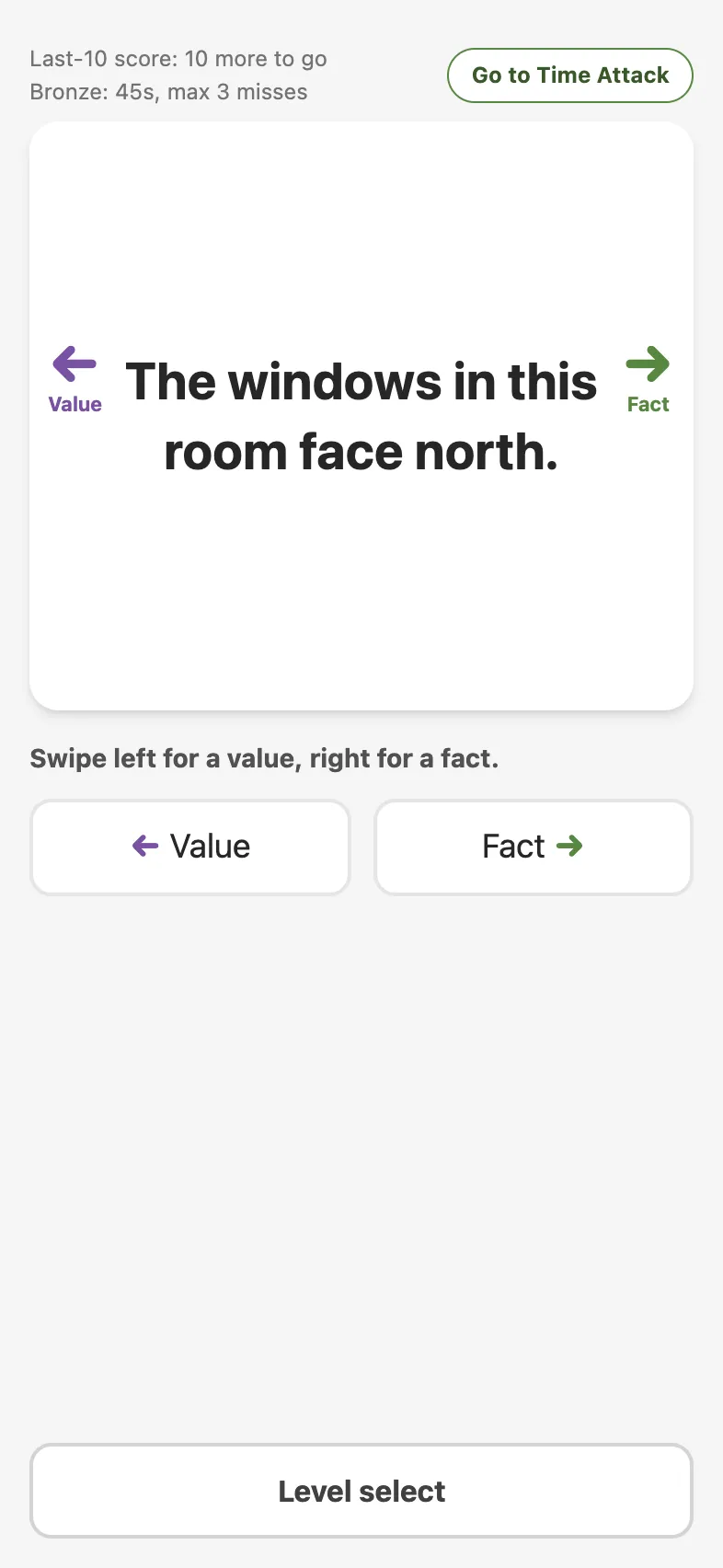
- E-1: Value or fact?
- E-2: Emotion or emotion data?
- E-3: Data or speculation?
- E-4: Which guess goes too far?
- E-5: Which one turns it into data?
F. Falsehood
- F-1: Lie, mistake, or pseudo-knowledge?
- F-2: Should you suspect falsehood?
How it works
Pick a level
If you're not sure, start with A-1. Course A covers the basics of the thinking you use in debate: questions and claims, for and against, and claims and premises.
Solve an example in the Guide
Ponder explains as you solve one example question. Examples don't count toward your records.
Think it through in Training
No clock, one question at a time. If you get one wrong, read the explanation before moving on.
Go for a medal in Time Attack
Once you're comfortable, take on a 10-question Time Attack. Start with bronze and work your way up to gold.
Connected to the book and to debate
The Thinking Gym gathers the practice questions for the book Critical Thinking in the Age of AI. You learn the theory in the book and make it stick here through repetition. You can read the opening pages in the Liffel Park Library.
Once you're used to choosing answers, it's time to write your own. In the Debate Colosseum, you write a constructive and a rebuttal against an AI, then get a verdict and feedback.
Frequently asked questions
- What is critical thinking?
- It means thinking things through rationally, step by step. In the Thinking Gym, you start by telling apart what you're thinking about (the question), what you're saying (the claim), and why you can say it (the premise). Then you practice the "conditions of rationality" one at a time: making the question clear, staying on the same question, making premises objective, and so on.
- Are the practice questions free?
- Yes. All the practice questions in the Thinking Gym are free.
- Do I need to log in?
- No. If you don't log in, your records stay only on that device. If you log in, your medals and personal bests are available on other devices, too.
- Can I use it on a phone?
- Yes. It's designed for phones first, and it also works on computers and tablets.
- Is it available in Japanese?
- Yes. Choose 日本語 at the top right of the screen to switch to Japanese questions. The English questions aren't translations of the Japanese ones; they were written separately so that you think in English.
- How hard is it?
- Course A is designed so that middle school students can solve it. From course B on, it gets harder step by step. There is no age limit.
Step into the Thinking Gym
The Thinking Gym is part of Liffel Park, a learning park for sharpening how you think and write.
Enter the Thinking Gym